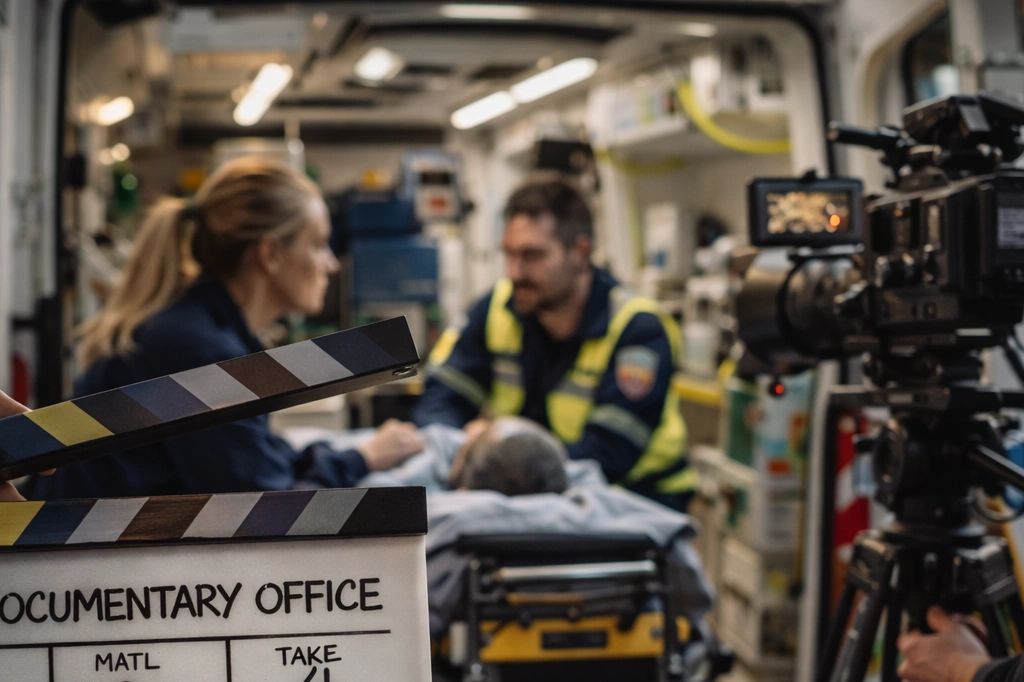
real people, real situations and real consequences

We make documentary-style films for leaders, teams and organisations navigating complex, sensitive stories.
We make documentary-style films for leaders, teams and organisations navigating complex, sensitive stories.

Context
Following the deregulation of the Australian gambling industry, a long-established Australian company was rapidly losing market share to aggressive new international competitors. Despite its size and cultural dominance, the organisation was struggling to understand how dramatically the market — and its customers — had changed.
A senior market research specialist was engaged to investigate the problem using traditional quantitative and qualitative research methods. While the data was sound, there was concern that research alone would not be enough to convince senior executives — many of whom were deeply invested in the company’s legacy — that radical change was required.
The Problem
The organisation was facing structural decline, but internally there was resistance to the idea that its core assumptions about gambling, customers and technology were no longer valid. Graphs, reports and presentations risked being dismissed as opinion rather than evidence.
What was needed was something that could not be easily argued with.
The Approach
I was commissioned to make a documentary that examined the gambling industry entirely from the perspective of gamblers themselves.
Rather than staged focus groups, the film followed a broad cross-section of gamblers — from traditional horse-racing regulars to younger, digitally native gamblers — in their real environments. This included time spent with bookmakers, venue staff and industry participants.
The approach was observational and non-judgmental. By spending extended time with participants, earning their trust and allowing the camera to recede into the background, the film captured unfiltered behaviour, attitudes and language.
The final documentary ran for 30 minutes and was intentionally engaging and accessible, allowing executives to absorb its findings emotionally as well as intellectually.
The Outcome
The film was used as the final and decisive element of the research presentation to senior management.
Executives were confronted with a clear and uncomfortable truth: their most loyal customers were ageing out of the market, while younger gamblers were engaging with gambling as a social, digital activity — and actively ridiculing the company’s existing technology and platforms.
The impact was immediate. Executives initially questioned whether the participants were actors — a reaction that only reinforced how confronting the material was.
The documentary succeeded in shifting internal thinking and played a critical role in the company’s decision to fundamentally redesign its technology and business model. The organisation stabilised and retained its position as Australia’s dominant gambling company.
Why it mattered
The documentary translated abstract research into lived reality. It allowed decision-makers to see, hear and understand the market in a way data alone could not — and enabled meaningful organisational change.
Context
A specialist medical practice focusing on bariatric surgery was working in a complex and emotionally charged space: the treatment of severe obesity.
Obesity is widely misunderstood — by the public, by patients, and often by medical professionals themselves. The practice wanted to move discussion away from simplistic narratives of personal failure and towards an evidence-based understanding of obesity as a chronic disease.
The Problem
Patients were struggling to access clear, honest information about surgical options, risks and outcomes. General practitioners, meanwhile, often lacked up-to-date knowledge and were hesitant to refer patients appropriately.
The subject matter required sensitivity, credibility and trust — anything resembling advertising or hype would undermine the message.
The Approach
I produced a series of short-form documentary films designed to speak directly and honestly to two audiences: patients considering surgery, and medical practitioners advising them.
The films combined:
The documentaries were hosted privately on the practice’s website and supported by carefully adapted short-form social media pieces designed to prompt thoughtful discussion rather than promotion.
The Outcome
The films proved highly effective and remain in active use years later.
Patients reported greater confidence and understanding when making decisions about their health. Medical practitioners engaged more constructively with the material and referrals increased in quality and appropriateness.
Why it mattered
The work demonstrated how documentary storytelling can clarify complex medical issues, support informed consent, and build trust without oversimplification or spin.
Context
A large energy provider was grappling with serious safety concerns. Despite extensive procedures and training, workers were still taking risks — often driven by time pressure, familiarity and a culture of informal shortcuts.
Traditional safety messaging was failing to cut through.
The Problem
Traditional top-down safety communications were not achieving the level of engagement required. Leadership recognised that messages could be misinterpreted if they felt instructional rather than collaborative.
What was needed was a more approachable and workforce-centred form of communication — one that reflected the voice, experience, and culture of the workforce itself.
The Approach
Rather than producing a conventional safety film, I built a documentary around a highly respected frontline worker who had survived a severe electrocution accident.
With care and trust, he was filmed returning to the site of the accident and later speaking openly about its impact on his body, his family and his life. He addressed his colleagues directly, in his own words.
The film avoided instruction and instead focused on lived experience and personal consequence.
The Outcome
The documentary became a central part of the organisation’s safety program and was widely regarded as one of the most effective safety communications the company had produced.
Why it mattered
The film succeeded because it replaced policy with credibility. Workers listened because the story came from someone they respected — not from management.

Context
A major Australian cultural institution was developing a permanent exhibition focused on biodiversity. The exhibition needed to explain how scientists work — in the field and in laboratories — to visitors of all ages and backgrounds.
The films would need to remain relevant and engaging over many years.
The Problem
Scientific work is often visually subtle and slow. There was a risk the films would either become dull or resort to sensationalism — both unacceptable outcomes for a long-term educational exhibition.
The Approach
I embedded with scientists in the field, working alongside them for extended periods to capture their process, concentration and quiet moments of discovery.
The films relied heavily on observation, body language and atmosphere rather than dialogue, as they were designed to run silently in busy exhibition spaces.
Close collaboration with museum curators ensured scientific accuracy while preserving narrative clarity and emotional engagement.
The Outcome
The films ran continuously for over a decade as part of the exhibition and were viewed by hundreds of thousands of visitors from around the world.
Why it mattered
The work demonstrated how documentary techniques can communicate complex scientific ideas in ways that are accessible, respectful and enduring.
Context
Not all documentary work is made to be watched passively. In some situations, film must actively support public understanding, behaviour change and decision-making — without tipping into advertising, persuasion or spin.
I have been engaged on multiple projects where the challenge was not simply to document a subject, but to translate insight into communication that people would trust, act on and share within their own communities.
Conventional marketing approaches often fail in environments where audiences are sceptical, risk-averse or culturally resistant to top-down messaging.
In these contexts, credibility matters more than polish, and trust must be earned through familiarity, relevance and respect.
Across several projects, I applied documentary thinking to communication design — starting with how people actually see themselves, who they listen to, and what language feels safe.
In regional and remote Australia, this included developing short-form films built around trusted local figures rather than institutions, and shaping narratives that felt communal rather than instructional.
In tourism work, it meant repurposing documentary footage into targeted, well-timed broadcast material — aligned to audience behaviour and economic cycles — rather than producing separate advertising assets.
In each case, the strategy, creative execution and distribution were developed as a single, integrated process.
In one public health initiative, immunisation uptake in remote communities increased dramatically — moving from among the lowest rates in the state to one of the highest — by replacing fear-based messaging with familiarity, humour and trusted local voices.
In a tourism campaign, documentary footage originally produced for broadcast was re-edited into regional television spots and strategically placed during peak post-harvest periods. The result was a sustained increase in visitation, with tourism numbers more than tripling over the campaign period.
These projects demonstrated that documentary methods can be applied beyond long-form films — helping organisations communicate responsibly, build trust and influence outcomes without sacrificing integrity.
The work succeeded because it treated audiences as participants rather than targets, and used storytelling to support understanding rather than persuasion.
If you’re dealing with a complex story, a sensitive issue, or a situation where clarity really matters, we’re happy to talk.
E: tomtom@bigpond.net.au
P: 0419707161 https:// scotttompson.com 🔗 LinkedIn | www.linkedin.com/in/scott-tompson-6b818519 ABN: 65 138 605 033